Jess Heritage
twofold
July 19th - 30th August
Messages never settle, instead they wander off, they shiver. They blow about like a draft through an open window.
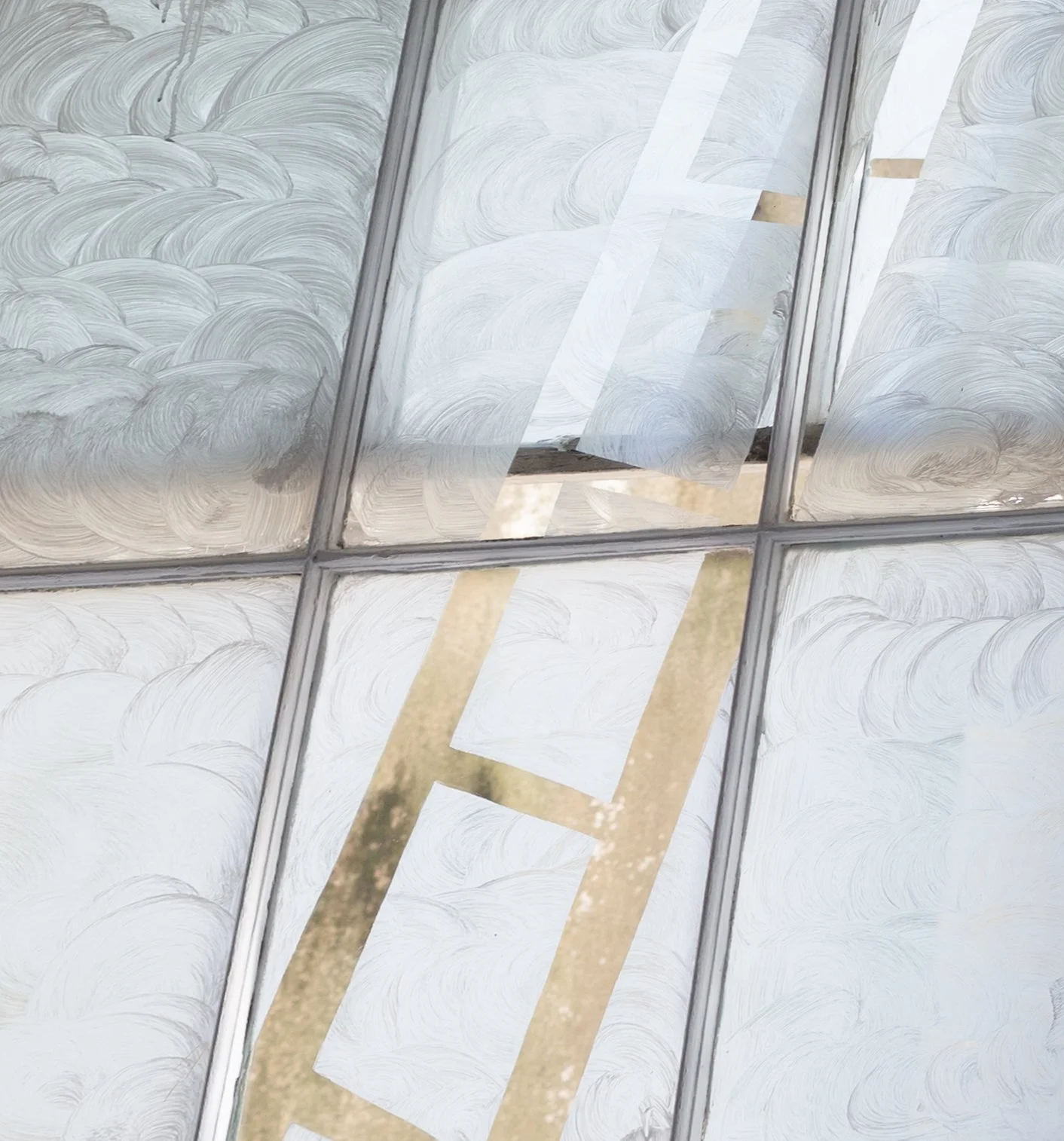
twofold is a site specific installation in which the windows of m2 gallery are whitewashed with emulsion. The gesture of whitewashing both disguises the preparatory stages of a space undergoing change, whilst simultaneously becoming a signal towards an interior which is caught in a state between done and undone.
Within twofold, the windows, clouded with white emulsion, become a vehicle for wavering typography that stutters from one pane to the next. The divisions of the windows act as an interruption, a hesitation in the message, which refuses to wholly settle.
Jess Heritage (b.1993, Pontefract) works predominantly with speech and performance.
The work often begins in the middle; a conversation already underway, or just out of earshot. Performances tend to circle around doubt and indeterminacy, producing registers of speech which falter, defer, or fail to wholly arrive. Her performances seek to make visible what is produced in the gaps and slippages that open up in communication; attempting to continually make present and undermine the often unacknowledged dominant structures inherent to language.
She often works with modest materials, building stripped-back and provisional architectural structures which exist in states of assembly or disassembly. These structures, like her register of speech, are understated and continually unresolved.
Jess graduated with an MA in Fine Art Media from the Slade School of Fine Art in 2025, and with a BA in Fine Art from Central Saint Martins in 2017. She was the recipient of The Perimeter Studio Award 2025, The Sarabande Foundation Scholarship 2023, and the Acme ASP studio award 2017-2019. Recent exhibitions include [sic] at Metroland Cultures, Between States at Chilli Art Projects and Same as it ever was at ANNEX at the Koppel Project.
https://www.jessheritage.com/
https://www.instagram.com/jess_heritage/
An essay in response to twofold by Zain Zainuddin August 2026
Bewitching words: language in Jess Heritage’s twofold
The Pavilion of the m2 gallery invites curious visitors off the street and onto the driveway of Quay House, where they circle the wooden cube, peer through its windows to an open space within. Across the white vitrine, they can see through onto the opposing window. Whitewash covers each of the four panes of glass, save for words stencilled out of the paint. The lettering in clear glass forms a sentence in distorted Times New Roman that gets cut off from one window frame and continues on the one to the right. You must walk around this Pavilion, trying to decipher and make sense of the sentence as you look through the cloudy glass. As you complete the arc, the sentence starts forming - “a knocking, so to speak, at the window of the image”.
Distorted and confusing as the sentence is, it makes you walk back and forth around the Pavilion, trying to reread it and discern what it means. Jess Heritage’s exhibition twofold takes this initial moment of intrigue as the starting point for her installation within the Pavilion’s four windows. At night, the pavilion glows with a cold white light shining out of its windows. Like moths, people move towards and shuffle around the Pavilion, putting their faces closer to the shining words. Through the negative spaces within the whitewash, you can see the little bits and pieces of the stencils used to cast the imprint on the glass. Curled up vinyl detritus lies in the white vitrine.
Whitewashed windows in a shopfront will exclude the passerby from peering and seeking out what is within. Yet by its mere presence, an opaque window is an invitation to think about what is being hidden and obscured from view. For now we see through a glass, darkly, as the biblical phrase goes. The window as symbol of knowing, of looking through, is frustrated as a temporary barrier is put in place, suggesting renovation, abandonment, or bankruptcy. Head down the main drag on Peckham’s Rye Lane and you will see many a business in transition hiding behind an opaque pane of glass.
The work brings to mind this gulf between the desire to know and the confusion of not knowing. The sentence stencilled across its windows is not easily digestible. There are no facile ways of describing what is being hidden from view here. Not what a knocking might entail, so to speak, nor what a window of the image might contain.
A lack of knowledge, confusion, bewitched words: our use of language as a tool often fails to grapple with what we mean or what we experience. Words are often deficient; some in excess, so to speak, signify and betray more meaning than we intend them to. For someone as sensitive to language as Heritage, what is also fascinating is the inheritances we carry around in our head from previous conversations, heard speeches, and written texts. How do these bear down into our choice of ordering words and phrases (in linguistics: syntax and constituents) whenstructuring and suturing meaning?
Central to her work is a consideration of this knocking, words as leaky cups of meaning that carry from one person to another. Inspired by art educator and artist Kate Love, who considered the use of language as an affective tool in her work (tracts both academic and artistic), Heritage’s work asks us to constantly be aware of the performative nature of words. 1The sheer act of putting experience to words is taken as the site of inquiry (a bit like how I am attempting right now to put words to the experience of Heritage’s œuvre).
Heritage has previously and effectively demonstrated this in her performance works, such as 2‘So, just before this begins…’at the South London Gallery. Beginning with hesitations, abstract introductions, a quavering voice and stammered sentences, she continues chatting to her audiences about her performance. She then smoothly repeats word-for-word the introduction she had just made, complete with all the stammers, off-hand turns of phrase, and vague abstractions.
There comes a moment when you realise the slippage into performance, and the porosity of the boundary between performed real life and art work. This experience of disidentification (is she really talking to me?) and misrecognition (is she really as uncertain as she’s letting on?) is for Heritage a generative experience.
This is because language, as something to be performed and consumed, is a regulatory affair. We prize clarity and brevity in writing. Hesitation, inarticulacy, and the fear of being misunderstood all arrest us and demand that we speak in ways which make ‘sense’. The rules of grammar force us to discard anything that isn’t easily explainable, and discourage us from speaking altogether if we can’t find the right words. The politics of speech will dictate our accent, our turns of phrase, and ask us to self-fashion a linguistic identity of class, gender, and nationality for our audience to consume and interpret. If we are to perform well in any way in front of the camera, in the workmeeting, or indeed in the art world, we must adhere closely to the rules of language.
Heritage is interested in the moment these rules come undone. In the window of the Meter Room is the second part of the exhibition: a small imprint of a bird smashed against the surface, looking almost accidental. It gestures to the failure of flight, of the falsity of transparent glass, and the imprint of trauma. Twofold is the instantaneous flow of information between interlocutors, like a bird striking the glass, a knocking at the window. After all, a bird print on the window is mortifying for everyone involved, most of all the proprietors of the window. As a symbol, it signifies a meaning that is in excess and should be wiped away.
Philosopher Giles Deleuze talks about these kinds of moments of rupture, when language breaks down. 3When grammar is confounded and the right words cannot be found, and only stuttering is left to allow the speaker to grasp at meanings. For Deleuze, these are moments of opportunity, an attempt at something new. A stutter, an incoherent slipping between seemingly disjointed concepts, is a lateral movement in logic that sutures ideas together even when they don’t make sense. At the window of the image is not just a bad phrase because it doesn’t make sense, it is a bad phrase because it confounds and ridicules our conceptions of the surface of the image. It gestures to sounds and image that are elsewhere, while we are stood at the window here and right now, looking at and through the Greenbergian ‘picture plane’.
So we are surrounded by language, and constituted by language, and made sense via language. Images can come knocking and burn themselves into your memory with words that lionise or an image can stick in your head with words that stammer annoyingly and inconclusively. For me, what is most thrilling about Heritage’s work is the form these words take. The font of the text, Times New Roman, evokes conservativeness and a regular serifed respectability, which she then drags out and degrades. In her performances, her words are accompanied by a warm, reassuring, low-toned Yorkshire accent, animated by a tone of voice which in its hesitations performs agendered sense of insecurity. Slyly, she then snaps the audience out of its lull when her words repeat, her focus gets concentrated, and the vinyl remnants you see through the window curls up and degrades.
When the rules of language are shrugged off, and its shackles and strictures are evaded and made less intelligible, it opens up new possibilities for us. While clarity allows us to grapple head-on with power, stammering helps us manoeuvre ourselves below the surface of the conversation. It allows us to deceive those who desire to order and control us. Heritage’s work asks us to consider both inarticulacy’s potentials and threats. How much room does our culture of rhetoric have for subjectivity, indecision, and the inability to articulate ourself? Are you listening closely?What opportunities have you foreclosed by refusing to understand a broken sentence, or by assuming meaning when there should be none? Who around you has the privilege to be inexact and vague? The politician, the migrant, the poet, the other? Heritage wants to deliver a knocking, so to speak, at the window of the image.
1Love, Kate. ‘Introduction to the Materiality of Writing as a Practice’. In An Affect of an Experience, and How I Learned to Write about It in the Context of Fine Art. Intellect, 2022. 1-58.
2The performance piece So, just before this begins… was performed as part of The Conch at the South London Gallery on 15 July 2026.
3Christa Albrecht-Crane. ‘Style, Stutter’. In Gilles Deleuze: Key Concepts, edited by Charles J.Stivale. Taylor & Francis Group, 2011. http://ebookcentral.proquest.com/lib/courtauldia/detail.action?docID=3060961. 142-152.
Zain Zainuddin is a student at the Courtauld Institute and a writer based in London.